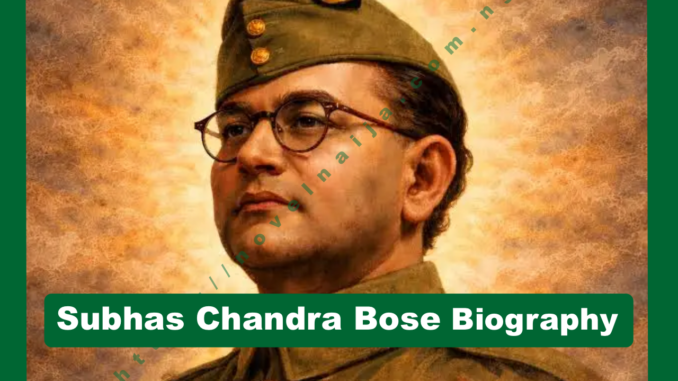
Explore Subhas Chandra Bose’s biography, age at death, wife Emilie Schenkl, daughter Anita, Indian National Army leadership and the mystery of his 1945 death.
Subhas Chandra Bose was an Indian nationalist leader and freedom fighter who played a major role in India’s struggle for independence from British rule. Popularly known as Netaji, he led the Indian National Army (INA) during World War II and advocated armed resistance against British colonialism. This Subhas Chandra Bose biography covers his early life, education, political career, wife, daughter, military leadership, and the controversy surrounding his death.
Born on January 23, 1897, in Cuttack, British India, Bose became one of the most influential figures in the Indian independence movement. He served twice as president of the Indian National Congress before forming the Forward Bloc in 1939. He reportedly died in a plane crash on August 18, 1945, aged 48, although questions about his death have continued for decades.
Quick Facts About Subhas Chandra Bose
| Detail | Information |
|---|---|
| Full Name | Subhas Chandra Bose |
| Popular Name | Netaji |
| Date of Birth | January 23, 1897 |
| Age at Death | 48 Years |
| Birthplace | Cuttack, Odisha, British India |
| Nationality | Indian |
| Profession | Freedom Fighter, Politician, Nationalist Leader |
| Father | Janakinath Bose |
| Mother | Prabhavati Devi |
| Wife | Emilie Schenkl |
| Children | Anita Bose Pfaff |
| Education | Scottish Church College, University of Cambridge |
| Political Parties | Indian National Congress, Forward Bloc |
| Famous For | Leadership of the Indian National Army |
| Reported Death | August 18, 1945 |
| Reported Place of Death | Taihoku, Japanese-ruled Taiwan |
Subhas Chandra Bose’s Early Life and Family Background
Subhas Chandra Bose was born on January 23, 1897, in Cuttack, then part of the Bengal Presidency under British rule. His father, Janakinath Bose, was a successful lawyer, while his mother, Prabhavati Devi, managed their large household. He was the ninth of fourteen children in a prosperous Bengali family.
Bose grew up in an environment that valued education, discipline, and public service. His elder brother, Sarat Chandra Bose, later became an important political leader and supported India’s independence movement. As a young boy, Subhas showed strong academic abilities and developed an interest in philosophy and Indian spiritual traditions.
His political awareness grew during a period of increasing opposition to British colonial rule. The writings of Swami Vivekananda and the teachings of Ramakrishna influenced his thinking about service and national responsibility. These early influences helped shape his commitment to India’s freedom.
Education and Indian Civil Service Examination
Bose began his education at the Protestant European School in Cuttack before attending Ravenshaw Collegiate School. He later studied at Presidency College in Calcutta but was expelled in 1916 following an incident involving a British professor. He subsequently enrolled at Scottish Church College, graduating with a degree in philosophy in 1919.
His father encouraged him to pursue a career in the Indian Civil Service, one of the most prestigious professions under British administration. Bose travelled to England and studied at Cambridge while preparing for the examination. In 1920, he passed the examination with an impressive fourth-place ranking.
Despite qualifying, Bose decided against serving the British colonial government. He resigned from the civil service process in 1921 and returned to India to join the independence movement. His decision marked the beginning of his political career.
Subhas Chandra Bose’s Political Career and Rise to Leadership
Joining the Indian National Congress
After returning to India in 1921, Bose became involved with the Indian National Congress and worked closely with nationalist leader Chittaranjan Das. He supported campaigns against British rule and gradually developed a reputation as a determined political organiser. His activities led to repeated arrests and periods of imprisonment.
Bose later served as mayor of Calcutta in 1930. He promoted stronger resistance to colonial rule and advocated complete independence rather than limited constitutional reforms. His growing popularity made him an important figure among younger Congress supporters.
Becoming Congress President in 1938 and 1939
Bose was elected president of the Indian National Congress in 1938 during its Haripura session. He supported industrial development, economic planning, and a more forceful campaign for independence. His political approach increasingly differed from Mahatma Gandhi’s emphasis on nonviolent resistance.
In 1939, Bose won re-election as Congress president, defeating Pattabhi Sitaramayya, who had Gandhi’s support. However, disagreements with senior party leaders made his position difficult. He resigned from the presidency and established the Forward Bloc later that year to unite more radical nationalist groups.
Escape From British India and Journey to Germany
British authorities placed Bose under detention because of his political activities. In January 1941, he escaped from house arrest in Calcutta while disguised and travelled secretly through northern India and Afghanistan. He eventually reached Germany, hoping to secure international support against British rule.
During his time in Germany, Bose established the Free India Centre and participated in broadcasts through Azad Hind Radio. He also helped organise the Indian Legion, which recruited Indian prisoners of war captured by German forces. His objective was to use Britain’s wartime enemies to advance Indian independence.
In 1943, Bose travelled from Europe to Japanese-controlled Southeast Asia through a difficult submarine journey. There, he assumed leadership of the Indian National Army and pursued his military campaign against British colonial rule.
Leadership of the Indian National Army
Taking Command of the Azad Hind Fauj
The Indian National Army was initially organised in 1942 with support from Indian nationalists and Japanese authorities. Bose assumed leadership in 1943 and transformed it into the central instrument of his military campaign. He encouraged Indian prisoners of war and civilians in Southeast Asia to join the struggle for independence.
On October 21, 1943, Bose proclaimed the Provisional Government of Free India, also called Azad Hind, in Singapore. The government received recognition from several Axis-aligned states and depended heavily on Japanese military support. Bose served as its head while directing the INA’s military and political activities.
His leadership popularised slogans such as “Jai Hind” and “Dilli Chalo.” He also supported the Rani of Jhansi Regiment, a women’s military unit commanded by Lakshmi Sahgal. The regiment reflected his efforts to involve women directly in the independence struggle.
INA Campaigns in Burma and Northeast India
In 1944, INA forces fought alongside Japanese troops during campaigns toward northeastern India. The operations included fighting associated with the battles of Imphal and Kohima. However, the offensive failed because of strong Allied resistance, supply shortages, and difficult conditions.
As Japanese forces retreated, the INA suffered serious losses and struggled to maintain its operations. Although Bose never achieved his objective of militarily liberating India, the army became an important symbol of anti-colonial resistance. The trials of INA officers after the war also generated widespread public attention across India.
Controversy Over Bose’s Alliance With Germany and Japan
Bose’s decision to cooperate with Nazi Germany and Imperial Japan remains one of the most debated aspects of his political career. He believed Britain’s enemies could provide military assistance to end colonial rule. However, both governments followed authoritarian and expansionist policies.
Historians continue to examine whether his relationships with these regimes were mainly strategic or also reflected ideological sympathies. His determination to achieve independence remains historically significant, but his wartime alliances also raise serious ethical and political questions.
Subhas Chandra Bose’s Wife and Daughter
Subhas Chandra Bose developed a relationship with Emilie Schenkl, an Austrian woman he met while working on his political writings in Europe. She assisted him with correspondence and manuscript preparation, and the couple are generally regarded as having married privately in 1937. Their relationship remained largely outside public attention during his political career.
They had one daughter, Anita Bose Pfaff, born in Vienna in November 1942. Anita later became an economist and pursued an academic career in Germany. She has also spoken publicly about her father’s historical legacy and the questions surrounding his death.
Subhas Chandra Bose’s Death and the Mystery of 1945
Subhas Chandra Bose reportedly died on August 18, 1945, after a Japanese military aircraft crashed in Taihoku, now Taipei, Taiwan. Accounts indicate that he suffered severe burns and died shortly afterward. He was 48 years old.
However, the circumstances surrounding his death became the subject of several official investigations. The Shah Nawaz Committee and Khosla Commission supported the plane crash account, while the Mukherjee Commission reached a different conclusion in 2005. The Indian government rejected the Mukherjee Commission’s findings and has maintained that Bose died in the crash.
Claims that Bose survived and lived secretly have circulated for decades, but they remain unproven. His reported death in 1945 is the account generally accepted in historical scholarship.
Legacy, Achievements and Parakram Diwas
Bose remains an important figure in India’s independence history. His leadership of the INA, advocacy of complete independence, and ability to mobilise supporters helped shape nationalist politics. His birthday, January 23, is officially observed in India as Parakram Diwas, or the Day of Valour.
In January 2026, India commemorated his 129th birth anniversary through national celebrations, exhibitions, and public events. Memorials, educational institutions, and public places also bear his name. His legacy continues to attract historical research and public discussion.
Final Thoughts
Subhas Chandra Bose’s biography reflects the life of a nationalist leader who rejected a comfortable administrative career to fight British colonial rule. His political achievements, military leadership, and controversial wartime decisions shaped his place in Indian history.
Although questions about his death remain part of public discussion, Bose’s contribution to India’s independence movement is widely recognised. His life continues to encourage reflection on patriotism, political choices, and the sacrifices involved in pursuing national freedom.
Frequently Asked Questions
Q1: Who was Subhas Chandra Bose?
Subhas Chandra Bose was an Indian freedom fighter and political leader who commanded the Indian National Army during World War II. He was popularly known as Netaji.
Q2: How old was Subhas Chandra Bose when he died?
Subhas Chandra Bose was reportedly 48 years old when he died on August 18, 1945. He was born on January 23, 1897, and would have turned 129 in 2026.
Q3: Who was Subhas Chandra Bose’s wife?
Subhas Chandra Bose’s wife was Emilie Schenkl, an Austrian woman he met during his time in Europe. Their marriage is generally dated to 1937.
Q4: Did Subhas Chandra Bose have children?
Yes, Subhas Chandra Bose had one daughter named Anita Bose Pfaff. She was born in November 1942 and became an economist in Germany.
Q5: How did Subhas Chandra Bose die?
Bose reportedly died from injuries sustained in a plane crash in Taiwan on August 18, 1945. Although alternative theories exist, the plane crash explanation remains the generally accepted historical account.
Q6: Why was Subhas Chandra Bose called Netaji?
Netaji is an honorific meaning “Respected Leader.” The title became widely associated with Bose during World War II because of his political and military leadership.
Q7: What was Subhas Chandra Bose’s contribution to India’s independence?
Bose advocated complete independence from British rule and led the Indian National Army in campaigns against British forces. His leadership and the subsequent INA trials influenced nationalist sentiment during the final years of colonial rule.
Leave a Reply